I had a great conversation recently with author Andrew (Grant) Child, the brother of Lee Child.
It was part of my writer-to-writer interviews, with five-to-ten-minute segments posted on my YouTube page every Wednesday.
Andrew took over writing the Jack Reacher Series from his brother a few years ago. His focus on the extraordinarily successful series follows a career writing some truly fun novels of his own. I personally loved his Paul McGrath novels. Paul, a former military cop (like Jack Reacher), works in a custodial role — a nondescript, everyday man with a passion for righting wrongs.
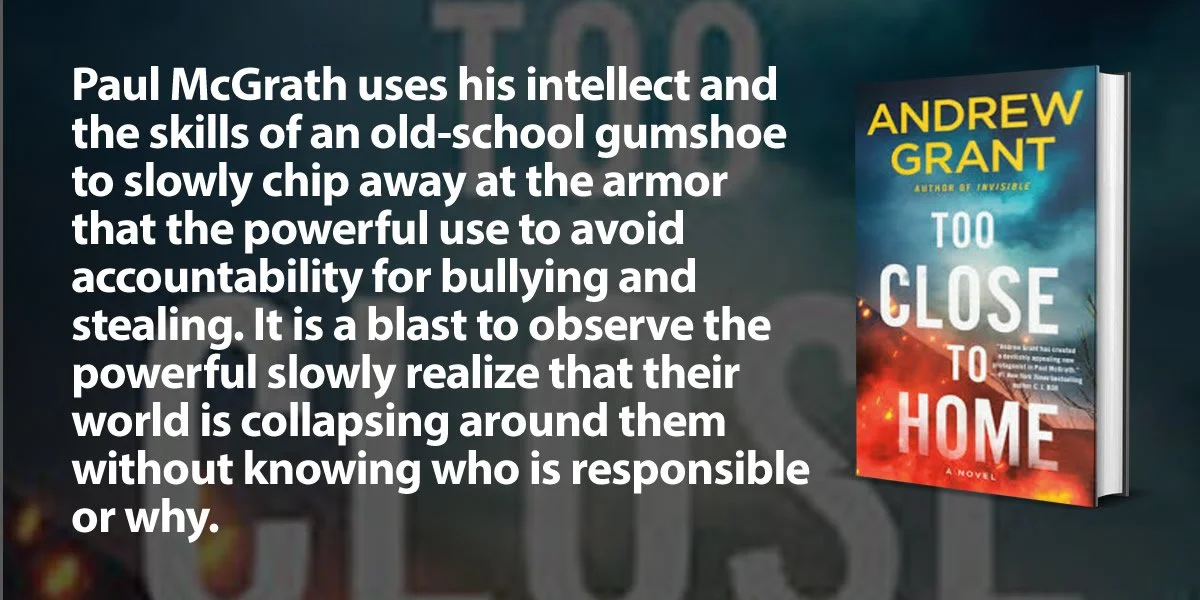
Andrew grew up in Birmingham, England, a book in hand. His favorite character was Robin Hood, a character with humanistic fervor and skills and a passion for defending ordinary people being abused by the powerful. Unlike Reacher or Mark Greaney's Gray Man characters, Paul McGrath doesn't leave gun smoke in the air wherever he goes. His intellect and the skills of an old-school gumshoe slowly chip away at the armor that the powerful use to avoid accountability for bullying and stealing. It is a blast to observe the powerful slowly realize that their world is collapsing around them without knowing who is responsible or why. Somehow it is more satisfying than seeing them blown to bits.
I love a shoot 'em-up, but between television and the plethora of superhero movies, we are inundated by them. It's fun to read a book that challenges the reader to think. Does the hero see the clues that the reader sees? Is the character truly evil, or just a little odd? Is the damsel in distress really an innocent girl? How is our 170-pound hero going to stand up to the 250-pound muscle protecting the bad guy? Settings so real that you are there. Plots that make you think, put you the reader into the story.
There's a bit of Robin Hood in most thriller adventure books, including mine. Both my historical-frontier adventure Gritt Series and my thriller Walker Series are written to make you think, to become part of the story yourself. Because so many of my stories are set in places most of my readers will never see — jungles of Mexico, the frozen North Sea, windswept Aleutian Islands, Siberia — I write to help the reader visualize the settings in their own imagination. Like Andrew, I invite my readers to be part of the setting and story. Look for books that make you think, from writers who know that when most of us find ourselves in terrible danger, there is little chance that someone is going to come charging in on a white horse to save us. We can save ourselves.
One other thing connected Andrew and me. After years of living in huge cities, Andrew and his wife took a cross-country driving trip and "found" the beauty and peace of wilderness Wyoming, where they bought a home. Alaska brought me that same peace years ago. We talked about how amazing it is to stop writing long enough to watch a moose wander across our property, possibly followed by a bear — a story of predator and prey. It is up to the moose to save itself.